
Merry Christmas! The Problem Site has two quick pieces of information to share with you this morning.
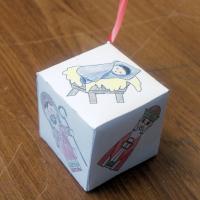
- Finally, our paper-craft ornaments are here! You can find cubes, dodecahdrons, icosahedrons and crosses, as well as tutorials for designing and executing your own craft ideas.
- Sometime in the next couple weeks we anticipate a short down-time for the site. This will probably be no more than a half an hour, but could take longer, as we transfer the site to a more powerful server. We've planned this down-time for Christmas vacation, as it is the lowest-traffic time of the year. In addition, we'll attempt to make the change-over happen early in the morning, eastern time. This will result in the least interruption for the majority of our users.
May you have a blessed holiday season, and a wonderful new year!
PS - if you're wondering about relative difficulty of the ornament projects, the cube is the easiest, and the dodecahedron is the hardest!
If you were on the site between 2:00 and 4:00 EST this morning (Thursday, March 29), you may have noticed some intermittent site outages. The server on which this site resides was undergoing significant upgrades. These are upgrades which will make the site more stable and responsive. As you play games today you will hopefully find that page loads are faster, and everything runs smoothly.
However, whenever there are significant upgrades, there is always the possibility of unexpected glitches. If you are using any portion of the site and discover that something isn't working right, you can let us know about the problems you're experiencing by visiting the Ask Professor Puzzler page and submitting a report.


Most of the games on this site are either word games or math games. There are a few miscellaneous puzzles and quizzes, but one thing we've never had on this site is an art game. That has now changed. Just this week the games "Color Picker" and "Closest Color" were added to the site. These games are both quizzes which are designed to help art students look at a color and recognize where it lies on the color spectrum, how saturated it is, and how light it is.
This is very useful for students who are interested in painting, and want to understand how hue, saturation, and lightness work together to form a color. A good understanding of these components will be of great value to artists who want to be able to match colors they mix to colors they see.
Color Picker Game: This game consists of 10 color swatches, and three slider bars. The slider bars allow you to select what you think the components of the color are. If you are "in the ballpark" the game moves to the next swatch - otherwise, you are required to adjust your sliders in order to zero in on the correct color. You can earn bonus points by being close or exact on the first try.
Closest Color Game: In this game you will be shown a swatch, and then three swatches which are similar to it, either in hue, saturation, or lightness. Your job is to identify the closest match.
We are working on developing a section of art games for the site - here is the page where new games will be added: Art Games.

We're delighted to announce the addition of Book Scrounger to our site. To scrounge, according to one dictionary, means "to actively seek money, work, or sustenance from any available source." Into this definition, insert the word "books" in place of "money, work, or sustenance," and you have Book Scrounger's definition of what she does: she actively seeks books from any available source.
In part, she does this for the benefit of her children, so you will find write-ups of many picture books, as well as history, science, and art books written for children. Her children are currently pre-school and kindergarten age, so the blog is currently "heavy" on that age level. Of course, over time, that will change.
In part, she scrounges books for her own pleasure, as she is an insatiable reader, and her bedside table is stacked so high with books in her to-read list that it will take her ten years to get through them all. Except...she keeps adding to the stack, so she may never finish them all. So in addition to finding books for children, you may occasionally find a more "grown-up" book.
In additional to all this, she occasionally permits her husband (the infamous Professor Puzzler of the "Ask Professor Puzzler" blog) to write a blog post.
Do you aspire to being a book scrounger too? If you wish you could have a "to-read" stack as tall as the Book Scrounger's stack, but you don't know how to get started with your scrounging habit, check out this handy list of suggestions the Book Scrounger has written: Book Scrounging Tips.
Note: If you're wondering why a "new" blog has posts dated back several years, the reason is simple: the older posts used to be part of our "Product Reviews" blog. These have been shifted over to the new blog, in order to keep all book reviews together.
In the aftermath of Hurricane Harvey, there are currently three more hurricanes in the Atlantic: Hurricanes Irma, Jose, and Katia. All three are concerning in one way or another, but Hurricane Irma has developed into one of the most powerful hurricanes on record. It is currently wreaking havoc in the Caribbean, and is headed in the direction of Florida.
As educators, we should be aware of these events going on in the world, and ready to talk to our students in compassionate and intelligent ways about them. My own students (I teach high school math at a small private academy) want to know what are the possible outcomes of these storms, what are the dangers involved, and who will be effected. Even though we live far from "hurricane country" (the last time a hurricane did any serious damage in our state was before my students were born), being part of a wider community means being both concerned and compassionate about the effects of these natural disasters.
Talking about the hurricanes, and the potential tragedies that may occur as a result of their passing, should be done in an age appropriate fashion. At the high school level, I used some math related questions as a launching point to spend a few minutes talking to my students about natural disasters. The students saw real-world application of mathematics, and had the opportunity to somberly reflect on what that mathematics meant from the perspective of humanity in the path of the hurricane.
If you would like to take a look at some of the discussion that took place in my math classes, you can visit the following links:
Under the Hurricane
Response to a question I received from a resident of Florida, who wanted to know how long she could expect her house to be "under" the hurricane. I used this question as a problem-solving exercise with my upper level math classes.
Waiting for the Hurricane
A write-up of a slightly more complex math question that I worked through with my students. The problem is to identify how long it will be before the hurricane reaches a specific point.
Hurricane Conspiracies
Professor Puzzler gets irate about the conspiracy theories and "fake news" floating around regarding hurricanes.
Tell Us about Your Lesson Plans
Have you done specific hurricane-themed lessons that you would like to share with others? You can send us a lesson plan. If we publish your lesson, we'll reward you with a ProMembership on this site!

Blogs on This Site


 Like us on Facebook to get updates about new resources