What's my equation?
The graph shown below consists of a line segment connected to a piece of a parabola, with the intersection at (0, 2). The derivative at the point of intersection is continuous, and each tick mark on the axes represents one unit. Find the equation of the parabola in the form p(x) = ax2 + bx + c.
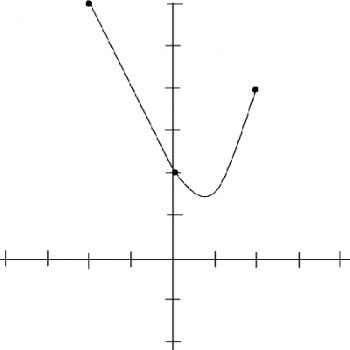
The graph shown below consists of a line segment connected to a piece of a parabola, with the intersection at (0, 2). The derivative at the point of intersection is continuous, and each tick mark on the axes represents one unit. Find the equation of the parabola in the form p(x) = ax2 + bx + c.

View the solution


Blogs on This Site


 Like us on Facebook to get updates about new resources