Use Heron's formula.
For any triangle XYZ, its area is equal to
√(s(s-x)(s-y)(s-z)), where s =
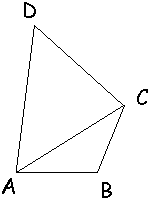
For triangle ABC, s = 3x + 3
Area = √((3x+3)(2x-1)(3-x)(2x+1))
For triangle ADC, s = 2x + 13
Area = √((2x+13)(2x+1)(3-x)(x+9)}
So, we want to solve the inequality
√((3x+3)(2x-1)(3-x)(2x+1)) > √((2x+13)(2x+1)(3-x)(x+9)}
It is compulsory that each of the multiplied terms in parentheses be greater than zero. If
- a were less than or equal to zero, we can derive a >= b + c, which violates the triangle inequality. We therefore can cancel out like terms while preserving the inequality - that is,
√((3x+3)(2x-1)) > √((2x+13)(x+9))
From triangle ABC, we are given
2x-1 > 0 -> x > 0.5 and
3-x > 0 -> x < 3
Quite conveniently, this guarantees that (2x+13)(x+9) > 1, so the special cases of √n > √m while n and m can be similtaneously between zero and one is irrelevant, and we can proceed directly to
2x
2 + 31x + 117 < 6x
2 + 3x - 3 ->
4x
2 - 28x - 120 > 0 ->
x
2 - 7x - 30 > 0
This is factorable.
(x-10)(x+3) > 0 ->
x>10 or x<-3
The intersection of this solution and the compulsory 0.5
Answer: Ø


 Like us on Facebook to get updates about new resources