 |  |  | | |
A Strong Will
A father in his will left all his money to his children in
the following manner:
$1000 to the first born and 1/10 of what then remains, then
$2000 to the second born and 1/10 of what then remains, then
$3000 to the third born and 1/10 of what then remains, and so on.
When this was done each child had the same amount. How many children
were there? view solution |
|  | |  | | |  |  |  | | |
Party Hardy
(Part A): There are 100 people in a ballroom. Every person knows at
least 67 other people (and if I know you, then you know me). Prove that
there is a set of four people in the room such that every two from the
four know each other. (We will call such a set a "clique".)
(Part B): Two people in the room are Joe and Grace, who know
each other. Is there a clique of four people which includes Joe
and Grace?
(Part C): Oops, I miscounted. There are actually 101 people in
the room, But it's still true that each knows at least 67 others.
That can't make a difference, can it? view solution |
|  | |  | | |  |  |  | | |
It's Cotton Candy for the Mind
Simplify the infinite product (1+x)(1+x2)(1+x4)(1+x8)(1+x16)...,
given |x| < 1. view solution |
|  | |  | | |  |  |  | | |
A Little Number Theory to Begin the School Year
Prove that if p and p²+8 are prime then so is p³+4. view solution |
|  | |  | | |  |  |  | | |
Tricky Quadrilateral Area
In the ABCD convex, general quadrilateral are given areas t1,
t2, t3. (t3:t2:t1 =
15:12:6) Calculate t4.

Note: MAB is the midpoint between A and B. view solution |
|  | |  | | |  |  |  | | |
---NO TITLE---
Not a terribly hard one, but one I like a lot.
Find the product: inf PI 10^(2^-n) n=0
Submitted by Dave Eview solution |
|  | |  | | |  |  |  | | |
Strange Sum
Let A1776 be the set { 1, 1/2, 1/3,
..., 1/1776 }
Remove any two elements, say a and b, from A1776, and
replace them with the single number ab+a+b to form set A1775.
Continue in this manner, until you have performed 1775 such operations, to
form set A1, which contains a single element.
What is this element?
Prove it! view solution |
|  | |  | | |  |  |  | | |
Oh, you can't be serious!
If 4x + 4-x = 7, then what is 8x + 8-x? view solution |
|  | |  | | |  |  |  | | |
Another Increasing Function
Maybe you remember that back in January, 2003, I offered you an
increasing function that met two criteria (click the problem archives to
see it). This month, I will challenge you with another increasing
function that meets two criteria...
Let f map positive integers to positive integers with the conditions:
i) f(n+1) > f(n)
ii) f(f(n)) = 3n
Find f(955). view solution |
|  | |  | | |  |  |  | | |
Interesting Integer Sequences
Let A be the set of all possible finite sequences (n0,
n1, ..., nk) of integers such that,
for each i = 0, 1, ..., k
i appears in the sequence ni times.
Here are some sequences in set A:
1,2,1,0
2,0,2,0
2,1,2,0,0
3,2,1,1,0,0,0
4,2,1,0,1,0,0,0
k-3,2,1,0,0,...,1,0,0,0
Are there other sequences in set A? If so, what are they?
Now prove it. view solution |
|  | |  | | |  |  |  | | |
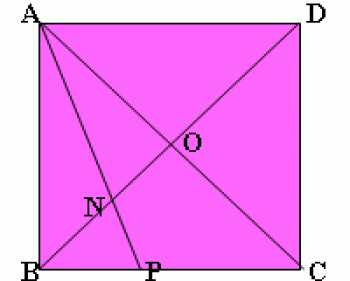
A Geometrical Diversion
The diagonals of a square meet at O.
The bisector of angle OAB meets
BO and BC at N and P respectively.
The length of NO is 24.
How long is PC? view solution |
|  | |  | | |  |  |  | | |
Evaluate this indefinite integral
What is the integral,
òdx/(x + sqrt(1-x²))
?
view solution |
|  | |  | | |  |  |  | | |
An Increasing Function for the New Year
Let f be a function from Z+ to Z+ where Z+ is the set of positive
integers, such that f satisfies these two conditions:
(1) f(n+1) > f(n); that is, f is strictly increasing
And
(2) f(n+f(m)) = f(n)+m+1
Find all values of f(2003) view solution |
|  | |  | | |
| |
|
Search For More Educational Resources
|
|
|
|